Edinburgh Castle map and layout: how the castle is arranged
The castle is one continuous climb, from the esplanade at Castlehill to the summit buildings around Crown Square. Below is the order you meet it in and what each stretch asks of your legs.
Updated 20 October 2026
In shortEdinburgh Castle is laid out as a single climb. The esplanade runs 110m of smooth tarmac at about 5 degrees to the gatehouse, then cobbles curve upward, uneven in places and reaching 15 degrees, past the batteries to Crown Square and the summit buildings. The standard exit drops 70 stone steps with a handrail, so you leave on a different line from the one you walked up.
110mEsplanade, smooth tarmac
about 5 degreesEsplanade gradient
15 degreesSteepest cobbled approach
70 stone stepsStandard exit route
Edinburgh CastleViewpoints over the castle and the cityNearby sights and the Royal MileEntrance, ticket office and meeting points
The castle, its entrance on the Esplanade, the Royal Mile meeting points and the nearby sights and viewpoints covered by the tours on this site.
Edinburgh Castle layout from the esplanade to the summit
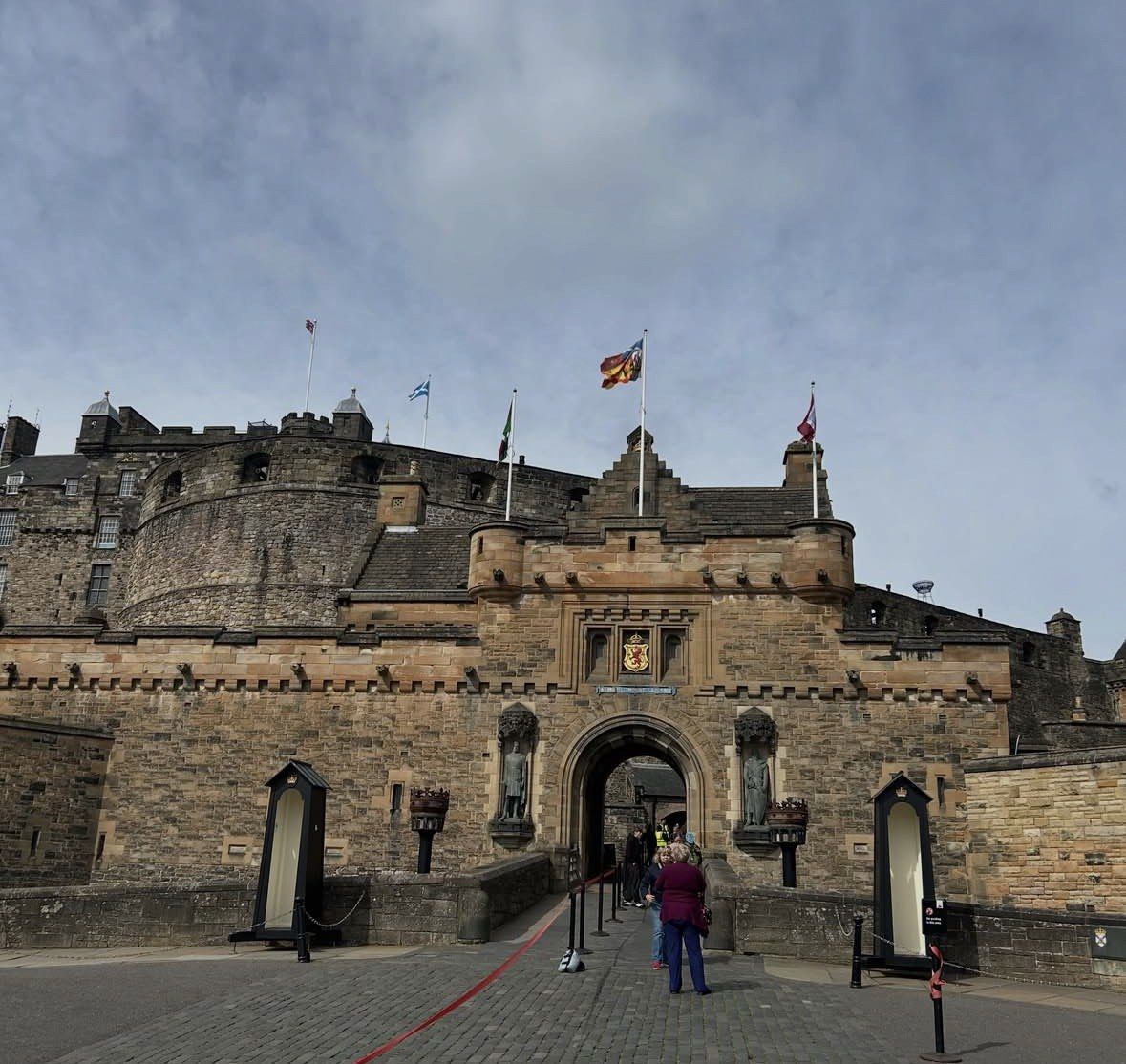
The esplanade at Castlehill is where the Royal Mile runs out of street and opens up. It measures 110m of smooth tarmac rising at about 5 degrees, the gentlest ground of the whole visit, and the ticket entrance and gatehouse sit at the far end of it. From May to October the temporary Tattoo structure takes up a large part of that space, which cuts down the room you have to stand and look back over the city.
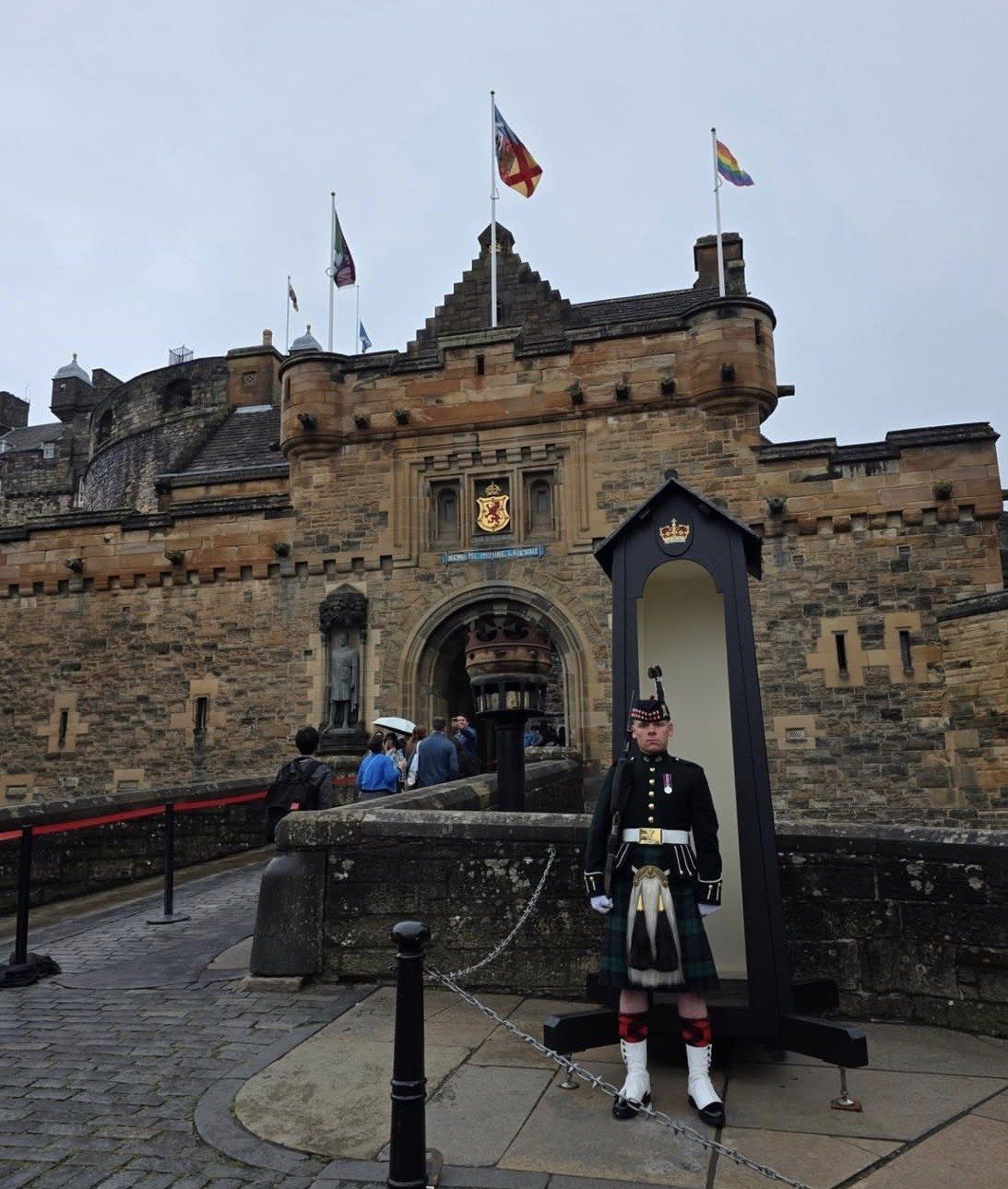
Past the gatehouse the surface turns to cobbles and the route bends. This is the steep part: curved, uneven in patches, 15 degrees at its worst. It carries you up through the lower defences to the batteries, the open walls on the north side facing Princes Street, where the 105mm One o'Clock Gun fires at 1pm every day except Sundays, Good Friday and Christmas Day.
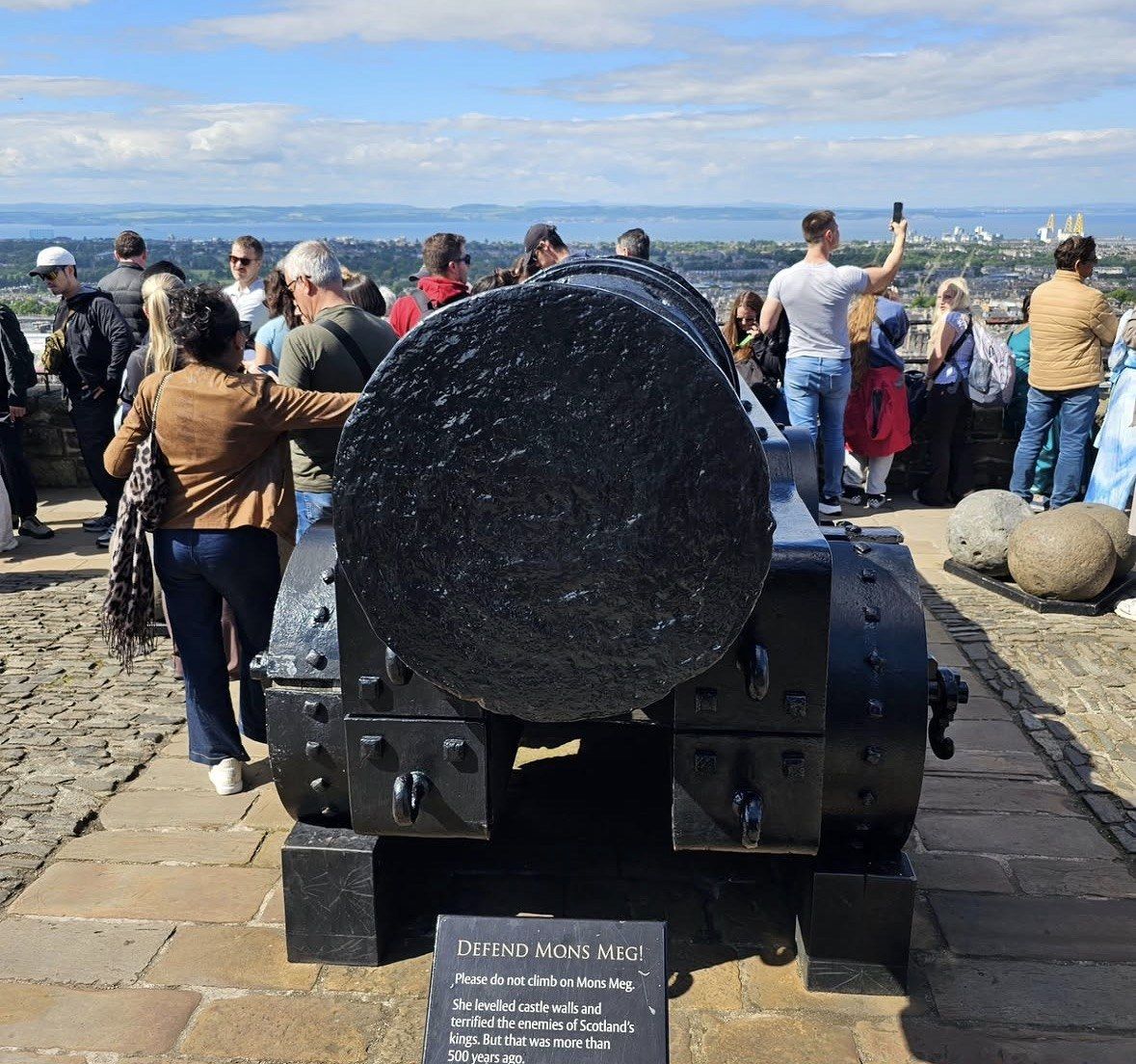
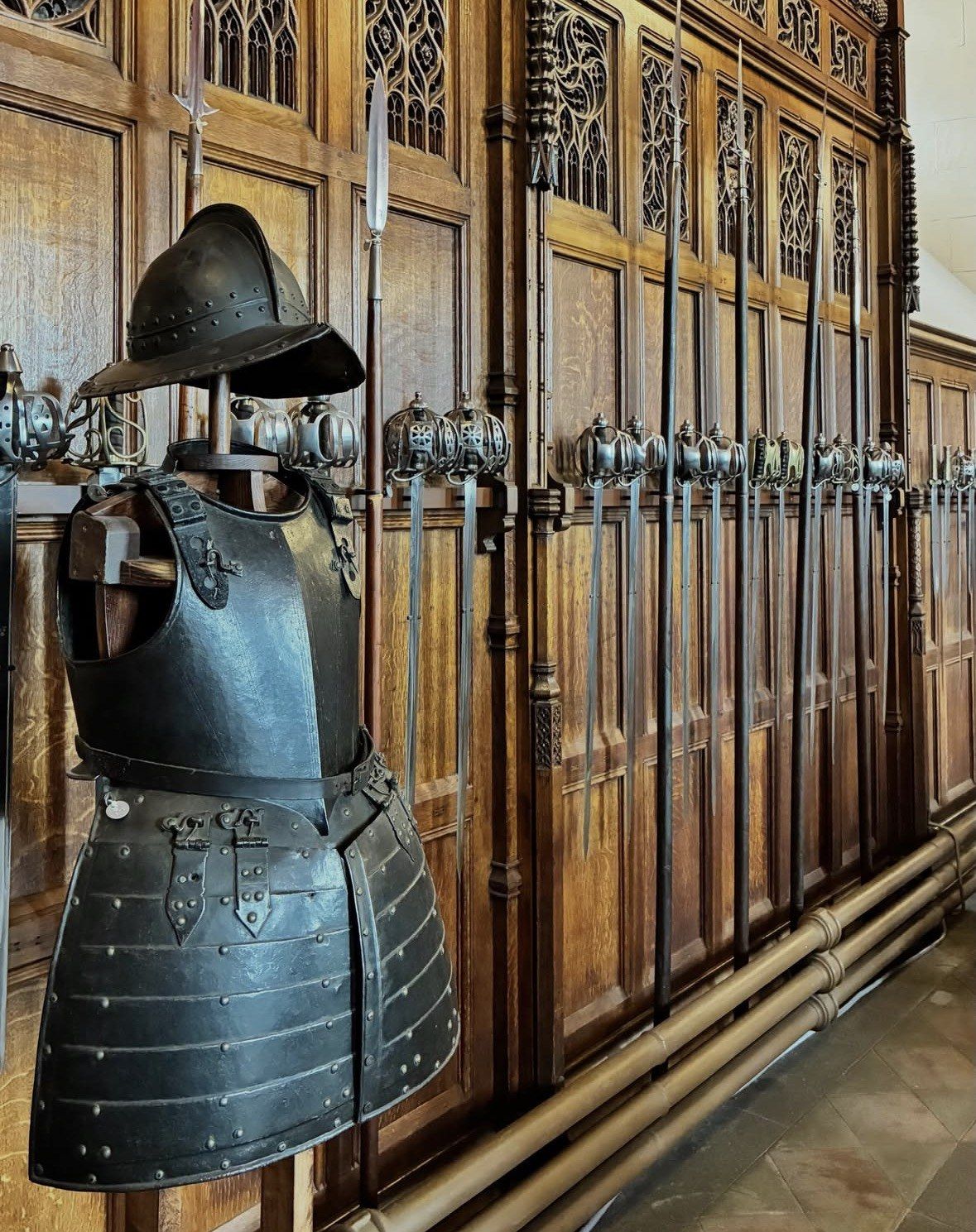
Higher up, Foog's Gate brings you onto the summit. St Margaret's Chapel stands here, built by David I around 1130 and the oldest surviving building in Edinburgh, with Mons Meg nearby: six tonnes of siege gun, given to James II in 1457 and last fired on 30 October 1681. Crown Square sits just below, a closed courtyard with the castle's main interiors on all four sides. Further round, the National War Museum occupies a former 1700s ordnance storehouse that later served as a military hospital. It opened in 1933, holds six galleries covering 400 years of Scotland at war, is run by National Museums Scotland and covered by castle entry, and is partially closed at present for essential building repairs.
Where you are
What is there
Underfoot
Esplanade, Castlehill
Ticket entrance, gatehouse, Tattoo stands from May to October
110m smooth tarmac at about 5 degrees
Lower defences and batteries
Walls over Princes Street, One o'Clock Gun at 1pm except Sundays, Good Friday and Christmas Day
Cobbles, curved and uneven, up to 15 degrees
Summit, above Foog's Gate
Chapel of St Margaret from about 1130, Mons Meg on its platform, dog cemetery in use since 1840
Cobbles and short rises
Crown Square
Crown Room with the Honours of Scotland, Great Hall completed in 1511, Scottish National War Memorial
Level courtyard once you reach it
Prisons of War vaults
Vaults beneath Crown Square, reconstructed as they looked around 1800
Stepped descent from Foog's Gate: numerous short flights, handrail on each side
Exit route
Brings you back down to the esplanade on a different line
70 stone steps with a handrail
Using the Edinburgh Castle map to get your bearings
The map on this page covers the approach rather than the interior. Put EH1 2NG into a phone and it drops you on Castlehill, the point where the Royal Mile stops climbing. On the map Waverley looks close, 0.4 miles, and that whole 0.4 miles is uphill. The tram stop at Princes Street measures the same 0.4 miles, Haymarket is about a mile off, and Lothian Buses run through the Old Town, with the Mound and George IV Bridge the stops the castle points visitors to. That last choice spares you part of the climb, which matters more than the extra few minutes on the bus.
Arriving from the airport, two lines put you on the same corner of the map: the Airlink 100 takes 25 minutes to Waverley Bridge, and the trams leave every seven minutes and run about 30 minutes to Princes Street. Neither sets you down at the gate. There is no public car parking at the castle; the nearest is the Castle Terrace NCP, and coaches drop off and pick up on Castle Terrace because Johnstone Terrace is closed to them.
Guided groups gather further down the hill. The 1.5 hours walk assembles outside Caffè Nero on the Royal Mile beside the statue of Adam Smith, downhill from the castle entrance and a short walk from both Waverley and the George IV Bridge stops; staff there hold green and white umbrellas with a Little Fish logo. Work out which point you are starting from before you fix your timings, because the last few hundred metres cost more effort than the distance suggests.
What sits around Crown Square
Crown Square is the top of the climb and the densest part of the castle, a courtyard with buildings on all four sides. Take the Crown Room door first, before mid-morning fills it: inside are the Honours of Scotland, the oldest crown jewels in the British Isles, brought together for the first time at the coronation of Mary Queen of Scots in 1543. Across the courtyard is the Great Hall, put up around 1510 and finished in 1511 as the setting for the state ceremonies of James IV.
The Scottish National War Memorial takes the north side of the square. Run by an independent charitable trust, it asks visitors not to photograph inside and to keep a respectful silence. Put the camera away at the door.
The Prisons of War vaults run under the paving you are standing on, and the way into them is from Foog's Gate, down numerous short flights of steps with a handrail on each side. What you walk into is a reconstruction set at about 1800. Look for the early Stars and Stripes scratched into a door, and the hole in the defences through which 49 prisoners escaped in 1811, still visible.
How steep the climb is, and how you come back down
The route up allows little choice. From the gatehouse the cobbled approach pushes everybody along the same curve through the lower defences, and the openings off it come in a fixed order: the batteries, then Foog's Gate, then Crown Square. Doubling back is possible, but it means walking against the flow on cobbles that reach 15 degrees, curve, and are uneven in places. Plan to see the batteries on the way up rather than on the way back.
Coming out is a separate route. The standard exit drops 70 stone steps with a handrail, so you do not retrace the cobbles and you reappear at a different point on the way to the esplanade. Agree a meeting point with anyone waiting outside before you go in.
Staff at the entrance can arrange a mobility vehicle up to Crown Square, which takes out the hardest stretch of the climb. Sort your bags out before you arrive: suitcases and rucksacks of 30 litres or more are refused at the gate, nothing can be stored for visitors, and bags may be searched on the way in. Dogs other than assistance dogs are not allowed anywhere on the route, roofed buildings included.
Esplanade: 110m of smooth tarmac at about 5 degrees, the easiest ground of the visit
Cobbled approach past the gatehouse: steep, curved, uneven in places, 15 degrees at the steepest point
Vaults from Foog's Gate: numerous short flights of steps, handrails on both sides
Standard exit: 70 stone steps with a handrail
Mobility vehicle to Crown Square: ask staff at the entrance
Skip the cobbled climb entirely
The private tour runs 3 to 4 hours from £245 with hotel pickup and drop-off, a professional local guide and castle tickets included, which suits families, small groups and anyone who would rather not take 15 degree cobbles on foot.
Both circuits below are built on the same baseline: at least two hours for the main attractions, museums and vaults included, is what Historic Environment Scotland, the registered Scottish charity in charge of the castle, tells visitors to set aside. Treat two hours as a minimum and plan more.
The short circuit goes straight up: gatehouse, cobbled approach, a pause at the batteries above Princes Street, then Foog's Gate and down into Crown Square for the Crown Room first, the Great Hall second and the Scottish National War Memorial third. Leave by the 70 steps. Time it so you are on the battery side by about 12.45pm for the 1pm gun, which published feedback says is loud enough to startle anyone not expecting it. The exceptions to plan around are Sundays, Good Friday and Christmas Day, when the gun stays silent.
The fuller circuit adds the summit and the vaults. Stop at the top for St Margaret's Chapel, Mons Meg and the dog cemetery, which has held regimental mascots and soldiers' dogs since 1840, then take the steps from Foog's Gate down to the Prisons of War before crossing into Crown Square. Finish at the National War Museum: partially closed at present, and from 1 October to 24 December open from 9.45am with last entry 4.30pm and closing 4.45pm.
Self-navigate or let a guide lead the climb
The layout is manageable on your own if you are happy reading a site plan and working out which arch leads where while a few thousand other people do the same. It is one climb in a fixed order, and the signage follows it.
A guide takes the route-finding and the timing off you, and settles entry before you arrive. Admission goes well before the visit date more often than people expect, summer especially, and once the online allocation has gone no reserve is kept back for arrivals at the gate. Booking a tour listed here whose facts confirm entry is included settles that part in advance, so the climb is the only thing left to arrange.
For the climb itself, the 1.5 hours walk, from £39 and rated 4.9 ★ (5901 reviews), covers a local guide plus the entry fees. The group forms on the Royal Mile outside Caffè Nero next to the Adam Smith statue, where the staff to look for carry green and white umbrellas with a Little Fish logo; gratuities are not included. Your ticket keeps you inside once the walk ends, which is how most people get past the two hour minimum without rushing. If you would rather not walk up the cobbles at all, the private tour runs 3 to 4 hours from £245, rated 4.7 ★ (18 reviews), with hotel pickup and drop-off, a professional local guide and castle tickets included, and food and drinks not included.
Questions people ask
How do I find my way around inside the walls?
Orientation inside the walls follows the climb rather than a grid, so the preparation that helps is knowing the order: esplanade, gatehouse, cobbled approach, batteries, Foog's Gate, summit, Crown Square, then out by the 70 steps. The map on this page covers the approach from Castlehill, the stations and the Royal Mile meeting point. On a guided walk the route-finding is the guide's job.
Can I visit Crown Square without doing the full climb?
Ask at the entrance for the mobility vehicle up to Crown Square: it removes the cobbled stretch that reaches 15 degrees. The vaults below the square are a separate matter, as they are reached from Foog's Gate by numerous short flights of steps, with handrails on both sides.
Do I come out where I went in?
No. The standard exit route takes you down 70 stone steps with a handrail and brings you back out on a different line from the cobbled approach you climbed. Fix a meeting point outside with anyone not coming in, and note where you parked before you start up.
Where should I stand for the One o'Clock Gun?
On the battery side facing the city, and be in place by about 12.45pm rather than arriving on the hour. What fires is a 105mm field gun, at 1pm, keeping up a signal set in 1861 to give shipping in the Firth of Forth a time check; Sundays, Good Friday and Christmas Day are blank.
How much of the layout can I cover in a short visit?
Official advice puts the minimum at two hours for the main attractions, museums and vaults included. A short circuit of batteries, Crown Room, Great Hall and the war memorial fits inside that. Adding St Margaret's Chapel, Mons Meg, the vaults and the National War Museum pushes you well beyond it, so plan a morning if you want the full round.
A local guide and the entry fees come with the 1.5 hours walk, from £39, which forms up on the Royal Mile by the statue of Adam Smith. Rated 4.9 ★ (5901 reviews).